The Story of Copper: Part 3
The Story of Copper: Part 3 – Other Copper Alloys and their use and Weldability
In the two previous segments on the Story of Copper, referenced in the attached links, we explained how this metal was created in the galaxy and how it was deposited on Earth. We also saw how significant copper was to the electrification of the planet where; free electrons can run riot in copper when a potential difference, or voltage, is applied across two poles. Additionally, we touched on two important alloys, Copper Nickel and Aluminum Bronze and briefly reported on their weldability and early development for marine applications. In this part of coppers story, we will take a look at three other alloys, phosphor bronze, silicon bronze and NAB and delve into these alloys’ use and weldability.
A list of the major copper alloys is shown in Table 1. From the metallurgical aspect, copper itself and many commercial alloys are so called single-phase solid solutions and cannot be strengthened by heat treatment. However, some alloys have two or more phases and can be strengthened by hardening methods such as quenching to produce a martensitic like microstructure and then tempered. This heat treatment behavior is similar to that which we apply to quenched and tempered steels.
|
1 |
Brass ----Copper-Zinc |
|
2 |
Phosphor Bronze----Copper-Tin |
|
3 |
Aluminum Bronze----Copper-Aluminum |
|
4 |
Silicon Bronze----Copper-Silicon |
|
5 |
Copper- Nickel |
Table 1 Major Groups of Copper Alloys
Copper and most of the copper alloys can be joined by the Gas Metal Arc (GMAW), Gas Tungsten Arc (GTAW) and Plasma Arc Welding (PAW) with Argon and Helium and/or mixtures of the two being used as the gas shield. Shielded Metal Arc (SMAW) can be used for non-critical fabrications but is generally limited to the flat position. The high energy beam process, Electron Beam Welding (EBW) can also be used but, this technique is expensive and uncommon due to the costs of equipment.
In Canada we do not have a CSA Standard for filler materials to be used for Copper and its Alloys. We, therefore adopt the American system, which is produced and defined by the American Welding Society. The standard for gas-shielded consumables is AWS A 5.7 ‘Specification for Copper and Copper Alloy Bare Welding Rods and Electrodes” and AWS A 5.8 Specification for Filler metals for Brazing and Braze welding
Phosphor Bronze
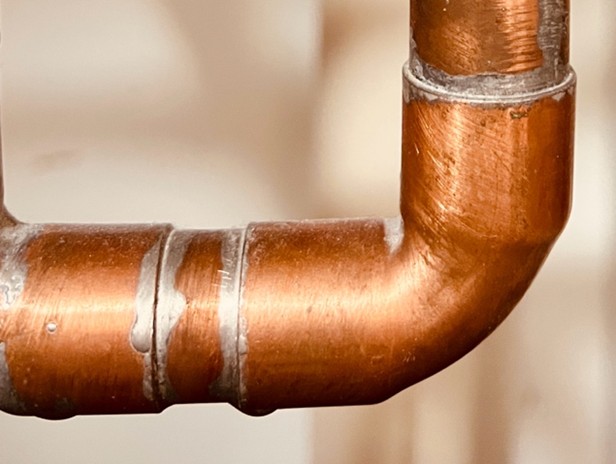
The most recognizable use for this alloy may be in its use for brazing water heaters and HVAC systems as seen in Figure 1. These are commonly brazed using copper-phosphorus brazing alloys (often referred to as phos-copper or by brand names like Sil-Fos). These are classified by composition and outlined in AWS A5.8/A5.8M aa alluded to above.
Silicon Bronze
Silicon bronze is a versatile, corrosion-resistant alloy widely used for marine, automotive (collision repair), heat exchanger tubing, marine hardware chemical process plant and aerospace. It is also used in the art sculpturing universe. Its property attractions include
- Corrosion Resistance: Highly effective against marine and chemical environments.
- Offers high strength and fatigue resistance.
Due to its high strength and low thermal conductivity, it is favored for repairing cast iron and welding thin-gauge automotive steels without damaging zinc coatings. DCEN polarity is used for GTAW and DCEP for GMAW using pure argon as the shielding gas and consumables that match the parent metal composition, e.g. AWS A 5.7 ERCuSi-A
There is a slight tendency toward hot cracking at elevated temperatures and such items would be addressed in a comprehensive weld procedural approach. Preheating is not required and interpass temperatures should be kept below 95 Deg C to prevent the previously mentioned hot cracking in the weld metal.
Nickel Aluminum Bronze NAB
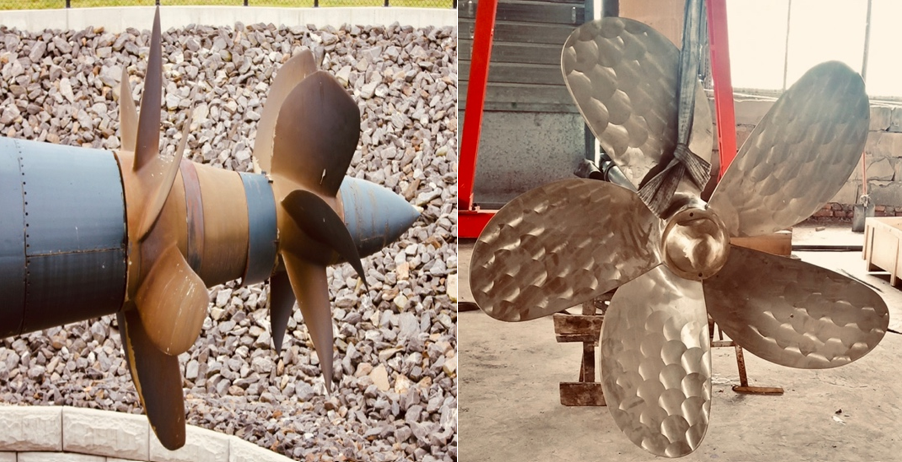
We touched on aluminum bronze in Part 2 of this story but Nickel Aluminum Bronze is a high-strength, copper-based alloy containing 9–12% Aluminum, plus ~5% nickel, which significantly boosts its corrosion resistance, especially in marine, high-cavitation, and acidic environments, making it superior for propellers, sea water valves, and pumps. NAB has a complex two-phase metallurgical structure and is capable of being quench hardened to give a harder martensitic like micro-structure. It is renowned for:
- Exceptional seawater corrosion resistance,
- Anti-fouling properties and high cavitation resistance.
- High Strength and Toughness: It has high strength, allowing for thinner, more efficient propeller blades, which reduces weight and stress on the shaft. Refer to Figure 2.
- Anti-Fouling: Its copper-based composition inhibits the growth of marine organisms.
- Acoustic Performance: It is often used for submarine propellers to help reduce noise, allowing them to operate silently.
The characteristic that gives the alloy its corrosion resistance is the strong tenacious aluminum oxide film that forms on the surface. This causes problems of oxide film entrapment and lack of fusion during welding and must be removed. Dedicated wire brushing of the surfaces before welding is necessary.
With respect to the welding processes, GTAW with square wave AC current to balance penetration and facilitate surface oxide breakup is used. With GMAW, the use of DCEP current breaks up and disperses the oxide film. Argon is the recommended shielding gas although a helium/argon mixture may be useful when welding very thick sections with the GMAW process Additional key requirements include using matching filler metals (e.g. AWS A 5.7 ERCuNiAl) and:
- Preheating: generally not required for thin sections, but a low preheat may be necessary for heavy sections. Interpass temperatures should be kept low to avoid hot cracking.
- Cleanliness. Removal of all oil, grease, and surface oxides prior to welding is necessary, as these can cause porosity and solidification (hot) cracking.
Post-Weld Heat Treatment (PWHT) is not always required, and would be included in a detailed weld procedure if necessary. However, stress relief can be beneficial for restoring some corrosion resistance and improving ductility after welding.
This completes our Story of Copper, an extremely important metal and one in which Canada is richly endowed. While it is not a main player in terms of total production at over 500,000 tonnes/annum its significance is growing due to the security of supply required for the North American continent.
Mick J Pates IWE
President PPC and Associates
Read The Story of Copper: Part 1
Read The Story of Copper: Part 2
Disclaimer
The information provided is intended for general interest, to educate and inform our audience. The CWB and those providing feedback to the questions do not take any responsibility for any omissions or misstatements that could lead to incorrect applications or possible solutions that industry may be facing.
How It Works content is submitted by Industry experts to the CWB Association and does not necessarily reflect the views of the CWB Group. When testing for CWB Certification or CWB Education, please refer to CWB Education textbooks or CSA standards as the official source of information.